
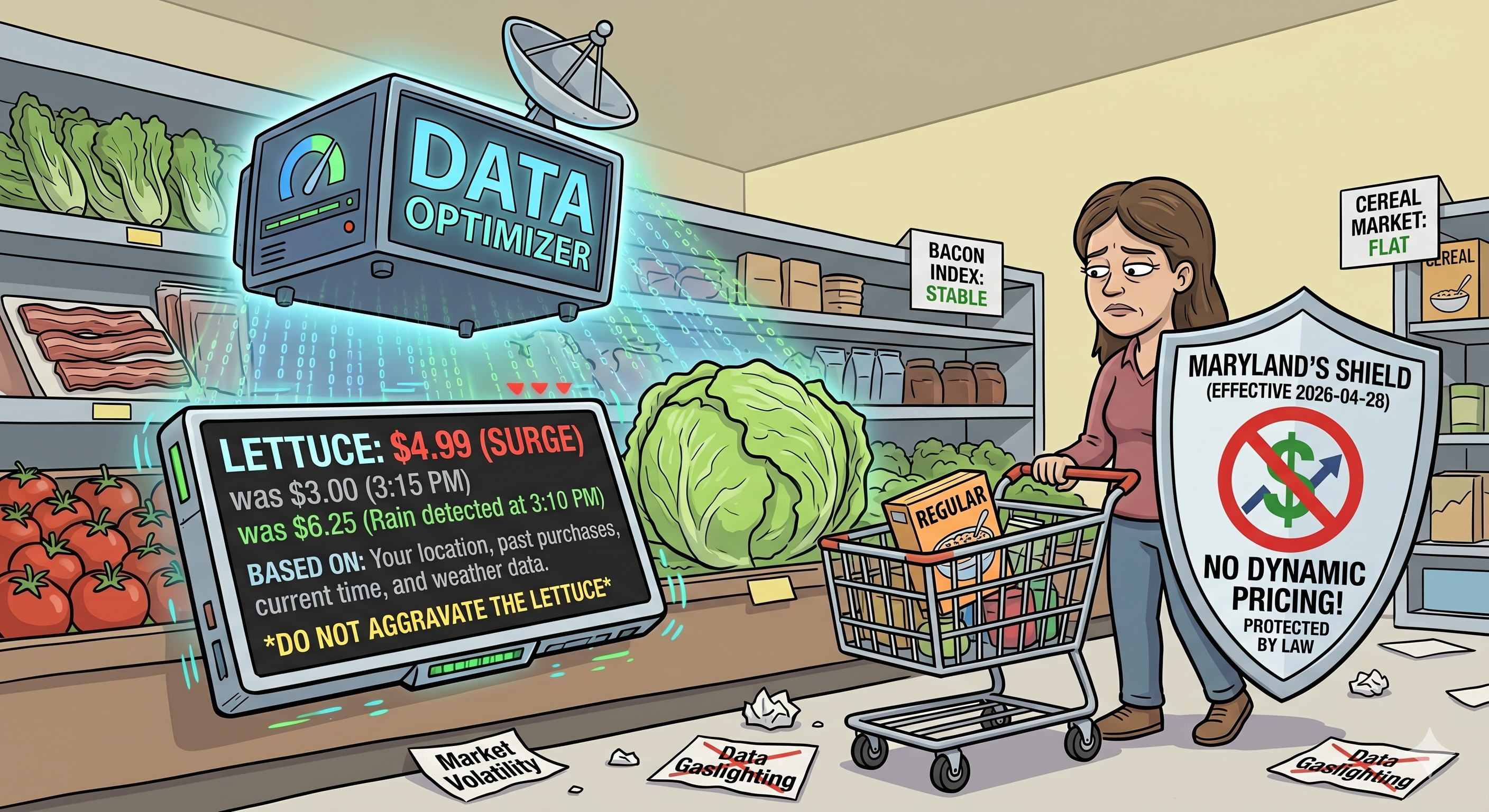
The Loyalty Card That's Loyal to Shareholders
You signed up for the loyalty card to save money on groceries.
Fair enough. Everyone's trying to stretch a dollar.
But here's what actually happened: You gave Kroger permission to track every item you buy, build a comprehensive profile of your household, enrich that data with third-party information about your income, race, and employment, and sell access to that profile to over 1,400 corporate clients.
Kroger estimates their data business is worth over $1 billion annually.
You got $3 off your grocery bill.
Congratulations. You're a profit center.
The 84.51° Empire
Most people don't know that Kroger owns one of the largest retail data analytics companies in America.
It's called 84.51°—named after the longitude of Cincinnati, where Kroger is headquartered. It employs over 1,000 data scientists. It processes purchase data from 60+ million households. It has become a separate revenue stream that rivals the profit margins on actual groceries.
84.51° doesn't just analyze Kroger's own data. It sells insights to over 1,400 corporate clients, including:
- General Mills
- Procter & Gamble
- Unilever
- Coca-Cola
- PepsiCo
- Kraft Heinz
- Johnson & Johnson
These companies pay to understand what you buy, when you buy it, what you buy alongside it, whether you're price-sensitive, whether you respond to promotions, and what your purchase patterns reveal about your household.
The yogurt discount was a loss leader. The data was the product.
What Your Grocery List Reveals
Every purchase is a data point. In aggregate, those data points paint an intimate portrait of your life.
Your grocery list reveals:
Your household composition
- Baby food and diapers → New parent
- Kid's cereal and lunch snacks → School-age children
- Senior-specific products → Aging household members
Your health status
- Sugar-free products → Possible diabetes
- Gluten-free items → Celiac or dietary sensitivity
- Pharmacy purchases → Specific health conditions
Your financial situation
- Store brands vs. name brands → Price sensitivity
- Bulk purchases vs. small quantities → Cash flow patterns
- When you shop relative to paydays → Income timing
Your lifestyle and beliefs
- Kosher or halal products → Religious practice
- Organic and sustainable items → Environmental values
- Alcohol purchases → Consumption patterns
Your relationships
- Sudden changes in purchase quantity → Relationship status changes
- Valentine's Day purchases → Romantic situation
- Baby shower items → Social connections expecting children
Grocers have been collecting this data for decades. What's changed is what they do with it.
Data Enrichment: When Your Grocery Store Knows Your Credit Score
Kroger doesn't just know what you buy. They know things you've never told them.
Retail data companies routinely enrich purchase data with third-party information from data brokers. That enrichment can include:
- Demographics — Age, gender, household size
- Financial indicators — Estimated income, credit range, homeownership
- Employment — Occupation, employer type, work schedule
- Ethnicity and race — Inferred from name, location, and purchases
- Life events — Recent moves, marriages, births, divorces
Your grocery store profile isn't just a list of what you bought. It's a comprehensive dossier, assembled from multiple data sources, designed to predict your behavior and monetize your attention.
The Kroger Plus card told them you buy organic milk. The data broker told them your estimated household income and whether you rent or own. Combined, you become a highly targetable advertising segment.
The Retail Media Gold Rush
Grocery stores have discovered something wonderful: they don't have to just sell groceries. They can sell advertising.
Retail media—ads served on retailer websites, apps, and in-store screens—is the fastest-growing advertising category in existence. It's projected to surpass television advertising revenue by 2028.
Why? Because retailers have something TV networks don't: they know exactly what you bought.
When Coca-Cola buys an ad on a TV network, they're hoping the right people see it. When Coca-Cola buys an ad through Kroger's retail media network, they can target people who:
- Have bought Pepsi products recently (conquest targeting)
- Haven't bought soda in a while (lapsed buyer reactivation)
- Buy snacks that pair with soda (complementary purchase behavior)
- Are about to check out (point of decision)
The targeting precision is unmatched. And the prices retailers can charge reflect it.
Your purchase data doesn't just help Kroger sell groceries. It helps Kroger sell ads. The margins on advertising are dramatically higher than the margins on milk.
The CVS HIPAA Waiver
If you're a CVS ExtraCare member and you've signed up for prescription rewards, you may have signed something disturbing.
CVS offers programs that give you $5 in rewards for filling certain prescriptions. To participate, many customers sign a HIPAA waiver that allows CVS to use their prescription data for marketing purposes.
Read that again. For five dollars, CVS customers are signing away their medical privacy rights.
The waiver allows CVS to:
- Track which prescriptions you fill
- Use that data to target you with related product advertising
- Share information with their retail media partners
You're on blood pressure medication? Here come the targeted ads for heart-healthy foods. You filled a prescription for a mental health medication? The algorithm adjusts your profile.
$5. That's what your medical privacy is worth to CVS. And millions of people have taken the deal.
Bluetooth Beacons: They Know Where You Walked
It's not just what you buy. It's how you shop.
Many grocery stores have installed Bluetooth beacons throughout their locations. If you have their app installed and Bluetooth enabled, the store can track:
- Which aisles you walk through
- How long you spend in each section
- What products you look at but don't buy
- Your path through the store
- Whether you use the restroom before or after shopping
This data helps stores optimize layouts. It also helps them understand shopping behavior at a granular level. They know if you lingered at the premium wine section before buying the cheap stuff. They know if you walked past the fresh vegetables and went straight to frozen dinners.
Your physical movement through the store is data. And data is money.
Tesco: The Loyalty Card That Ate Britain
If you want to see where American grocery data collection is heading, look at the UK.
Tesco Clubcard has achieved over 80% household penetration in Britain. Eight out of ten households have handed their grocery data to a single company.
Tesco has used this data to:
- Build one of the UK's largest advertising businesses
- Expand into financial services (banking, insurance, credit cards)
- Create detailed consumer segments sold to third parties
- Price-discriminate by charging different prices to loyalty members vs. non-members
In 2024, Sainsbury's (a Tesco competitor) announced plans to use loyalty card data to sell advertising for cars, credit cards, and other non-grocery products. The grocery store that knows what you eat now wants to sell you a vehicle.
This is the future of grocery retail. The food is incidental. The data is the business.
The Price Discrimination Question
Loyalty cards create a two-tier pricing system. Members get discounts. Non-members pay full price.
But who actually benefits?
Studies have shown that loyalty card "discounts" often aren't discounts at all. The "regular" prices are inflated specifically so the "member" prices seem like deals. You're not saving money with the loyalty card. You're paying the normal price while everyone else is getting ripped off.
And the more data the store has about you, the more precisely they can price-discriminate. If they know you always buy a specific brand no matter the price, why would they give you a discount on it?
The loyalty card promises savings. What it delivers is just enough savings to keep you handing over data.
What You Can Do
If you want to keep using loyalty programs:
Use a dedicated email address. Don't connect your grocery rewards to your primary email. Limit the linking.
Provide minimal information. Use a fake birthday. Use a phone number that isn't your primary. Give only what's required.
Opt out of data sharing. Most programs have (buried) settings to limit third-party sharing. Find them.
Don't install the app. Use a physical card instead. The app tracks much more than purchases.
Turn off Bluetooth when shopping. Prevent beacon tracking.
If you want to opt out entirely:
Pay cash without a loyalty card. The old-fashioned approach works. No card, no tracking (though store cameras and other systems still exist).
Use privacy-focused alternatives. Some co-ops and independent grocers don't have data-harvesting loyalty programs.
Request your data and then delete your account. Under CCPA (California) and similar state laws, you can request what they have on you and then demand deletion.
Understand the trade-off:
Calculate the real value. Track how much you actually save with the loyalty card versus what your data is worth. The math probably doesn't favor you.
The CVS HIPAA waiver? Don't sign it. $5 is not worth your prescription privacy.
The Bottom Line
Your grocery store has become a data company that incidentally sells food.
Kroger's data business is worth over $1 billion. They have 1,400+ corporate clients paying for access to your purchase behavior. They've enriched your file with third-party data about your income, your race, your employment.
You got a coupon for 50 cents off crackers.
The loyalty card was never about loyalty. It was about data capture. About building profiles. About creating an advertising platform more valuable than the groceries on the shelves.
Every item you scan is logged. Every aisle you walk is tracked. Every pattern in your shopping is analyzed, packaged, and sold.
The store knows you buy ice cream at 2am after bad days. General Mills knows. Unilever knows. The retail media network knows.
You thought you were saving money on groceries. You were funding a surveillance operation.
That loyalty card in your wallet? It's loyal alright.
Just not to you.
Sources: Kroger investor presentations on 84.51°; retail media industry analysis; CVS ExtraCare program terms; Tesco Clubcard penetration data; academic research on loyalty program economics; FTC retail data practices reports.