
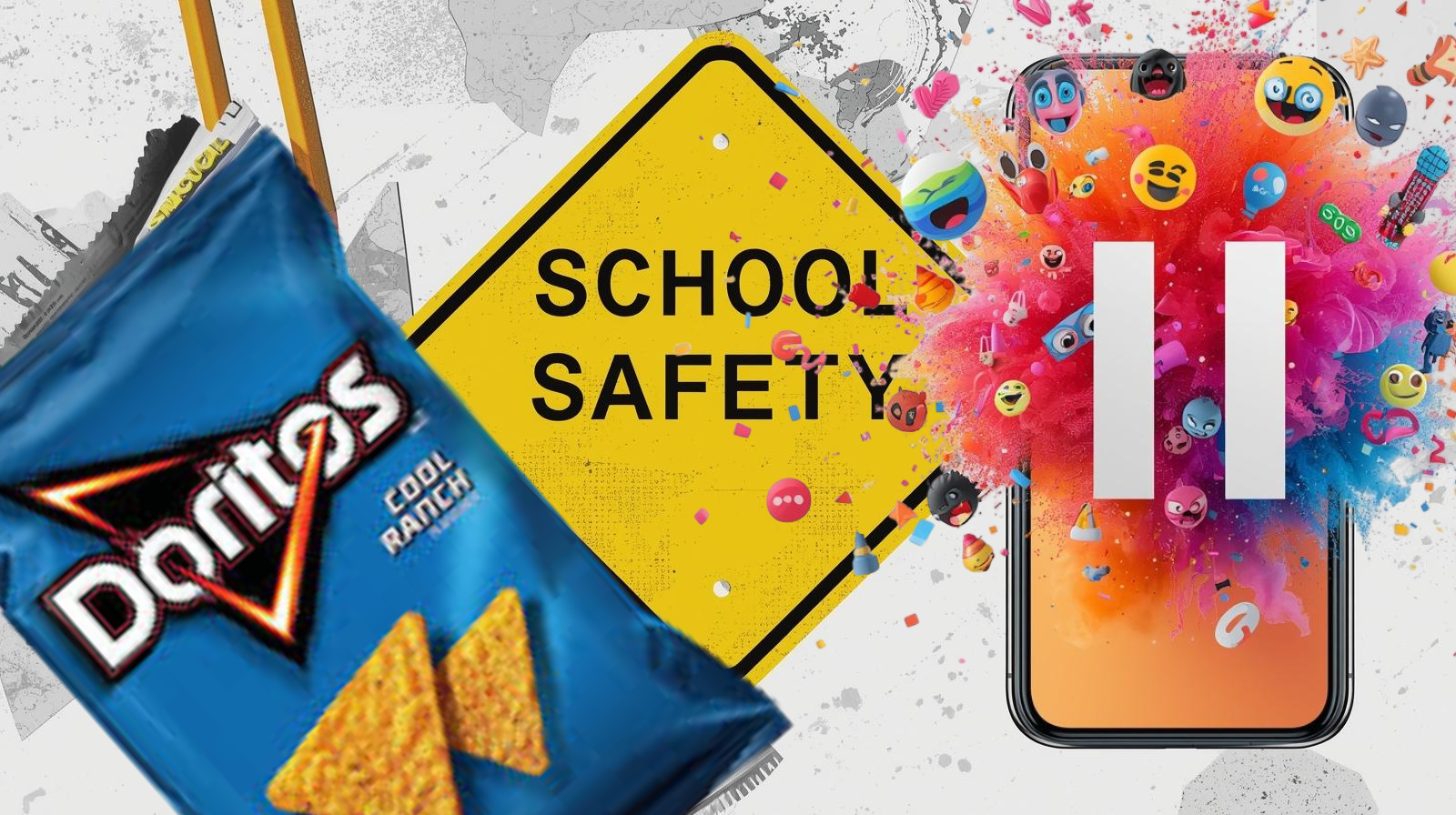
Picture this: it is after football practice at Kenwood High School in Baltimore County. A 16-year-old, Taki Allen, is hanging out with friends, eating a bag of Doritos. He crumples the empty bag and slips it into his pocket.
Minutes later, eight police cars pull up. Officers arrive with guns drawn and order him to the ground.
Why? Because an AI-powered gun detection system watching the school's cameras thought the bag of chips was a firearm and flagged him as a threat.
That is right: Doritos = gun, according to the algorithm.
Welcome to the future of school "security tech."
The Kenwood Doritos Incident: A Snack Attack That Wasn't
Let us walk through what happened at Kenwood High School.
- The student finishes a bag of Doritos after practice and pockets the crumpled bag.
- An AI gun detection system, from vendor Omnilert, analyzes video feeds from school cameras.
- The system flags what it believes is a gun and sends an alert.
- Police respond in force. The student is ordered to the ground and handcuffed.
- No weapon is found. The only object is the chip bag, which the student had been holding with one finger extended in a way that confused the system.
The district later admitted the system was wrong and said it would review procedures and retrain staff who respond to AI alerts. The student, meanwhile, said he no longer feels safe and avoids being outside after school.
From the outside, this story sounds like a bad joke. Inside that moment, for the kid surrounded by armed officers, it was anything but funny.
What Actually Went Wrong? (Hint: Not The Chips)
This was not a one-off fluke from a perfect system. It was the predictable result of how these tools are built and used.
False positives: when "better safe than sorry" becomes "sorry about your trauma"
AI vision systems are trained to recognize shapes and patterns. In this case:
- Crumpled chip bag
- Held at about the right angle
- Finger extended in a way that mimicked a barrel or grip
The system saw a gun silhouette where there was none. That is a textbook false positive: an alert with no real threat behind it. Vendors often promise low error rates, but they rarely talk about what those errors look like in real life: kids on the ground, sirens, handcuffs, and long-term fear.
Automation overreliance: "The AI said so"
Humans love shortcuts. If a system is sold as smart, advanced, or cutting edge, people tend to trust it more than they probably should. That is called automation bias.
In many schools, if the AI alert pops up, staff are conditioned to act as if it is real. They assume the machine is correct and escalate quickly.
The problem:
- The system does not understand context
- The system does not understand intention
- The system only sees shapes and probabilities
Policy and training lag behind the tech
According to the Center for Democracy and Technology (CDT), schools across the United States are adopting AI and algorithmic tools much faster than they are building policies and training to govern them.
That means:
- Staff are not always trained on the limits of the tech
- Students and parents are not clearly informed how systems work
- There is often no transparent way to challenge errors
When your safety plan is "hope the AI is right most of the time," you do not have a safety plan. You have a marketing slide.
Bias and blind spots
AI systems are not neutral. They are trained on data chosen and labeled by humans. That can introduce subtle patterns and biases in what they flag as suspicious.
Education experts and civil liberties advocates have warned that as schools deploy AI surveillance, students of color and already over-policed communities may be hit hardest by false positives and heavy-handed responses.
The chilling effect on normal life
After the Kenwood incident, the student said he no longer feels comfortable waiting outside after school and is anxious about being misjudged again. That is the chilling effect in action.
If students worry that eating chips, wearing a hoodie, or standing in the wrong place might get them flagged by AI and swarmed by police, are they really safer? Or just more controlled and afraid?
The Bigger Picture: AI Is Creeping Into Schools Everywhere
The Doritos incident is a meme-ready example, but it is not isolated. It is part of a much bigger trend.
AI is rapidly expanding in K-12 schools
According to Education Week and related research:
- AI is being used for everything from cheating detection and behavior monitoring to camera analytics and "threat detection."
- Experts warn about serious risks, such as data breaches, tech-fueled harassment, biased decision-making, and over-surveillance.
- Many districts do not have robust AI policies, clear guidelines, or transparency around how these tools are used.
CDT's work highlights that schools adopting AI often lack strong oversight, evaluation frameworks, or independent auditing. In simple language: the tech is racing ahead, while the rules and ethics jog behind, trying to catch up.
Surveillance culture in the name of safety
More cameras, more scanning, more analytics, more dashboards. Students are increasingly watched in the name of protection.
The concern is not "no security." It is this:
- Tech can make it feel like everything is handled
- Meanwhile, root causes of violence, bullying, and mental health crises get less attention
- It is easier to buy a new gadget than to invest in counselors, social workers, and community relationships.
What Do Fake Tech Keynotes And QR Code Traps Have To Do With This?
The "fake tech keynote" problem in school safety
Imagine the pitch to a school board: "With our AI gun detection platform, your campus becomes smarter and safer. Real-time alerts. Instant police notification. Peace of mind."
The slide deck is glossy. The demo video shows a clean animation of a gun being detected, alert icons flashing, officers heroically responding in a controlled way.
What it does not show:
- A scared teenager with chips
- Eight police cars
- Parents getting emergency calls without understanding what happened
- A community that now has to ask whether the system is worth the risk
That gap between the keynote story and the lived reality is exactly the "fake tech keynote" vibe.
QR code traps in the education world
Schools and vendors have fallen in love with QR codes for visitor check-ins, student surveys, "mental health check" portals, and parent communication. QR codes are convenient. They are also a smooth way to route people through data collection funnels and poorly secured websites.
Scammers and attackers know this. A malicious QR code that mimics a school portal can harvest parent login credentials, redirect to phishing or malware pages, and trick people into entering sensitive info.
So What Should Real Student Safety Look Like?
1. Relationships first, sensors second
Students who feel known and supported are more likely to report problems early. No camera can replace a counselor who knows when a student looks "off" that day.
2. Human judgment built into every tech workflow
If a system sends an alert, there should be a trained human reviewer, clear criteria for escalating to law enforcement, and documented protocols that slow down reactions when there is low confidence.
3. Transparency and accountability
Parents, students, and staff deserve to know what AI tools are being used, what data they collect, how long that data is stored, and how often they produce false positives.
4. Bias audits and equity checks
Any system that can call the cops on a kid needs independent testing for bias, analysis of which groups are disproportionately flagged, and ongoing reviews.
5. Smarter use of tech, not more tech for its own sake
AI can help with anonymous tip reporting, pattern analysis on bullying or harassment reports, and flagging written content that suggests self-harm so counselors can step in.
How Parents, Students, And Educators Can Push Back
Questions to ask your school or district
- What AI and automated systems are we using for security?
- Who decided to buy them and based on what evidence?
- What is the documented false positive rate and how is that tracked?
- What happens when the system is wrong?
- How do we audit for bias and disproportionate impact on different student groups?
- What data is collected, who has access, and when is it deleted?
How to talk to kids and teens about this stuff
- Explain that sometimes "smart" systems get things very wrong
- Encourage them to tell an adult if they feel unsafe because of how tech is used
- Teach them not to scan random QR codes, even in school settings, unless they come from a verified source
The goal is not to make them scared of everything. It is to teach healthy skepticism about systems that claim to be magical solutions.
Final Takeaway: Do Not Confuse Shiny Tech With Real Safety
The Doritos incident is more than a wild headline. It is a symptom of a bigger pattern:
- We are buying impressive-sounding AI security tools faster than we can govern them
- We are training people to trust alerts that are not always trustworthy
- We are replacing relationship-based safety with automation that does not understand context
Real safety in schools is not about turning campuses into airports with homework. Real safety is strong relationships, transparent technology, thoughtful policies, and clear limits on what AI can and cannot decide.
If we get that right, maybe the next time a kid finishes a bag of chips, the only thing that happens is crumbs on their shirt, not sirens in the parking lot.
And if you ever see a vendor demo where the AI system heroically spots a weapon in a dramatic video, feel free to raise your hand and ask: "Cool. But what happens when it thinks a snack is a gun?"
Because until that question has a better answer than "eight police cars," we still have work to do.