
If you've attempted to use technology recently, congratulations on your courage.
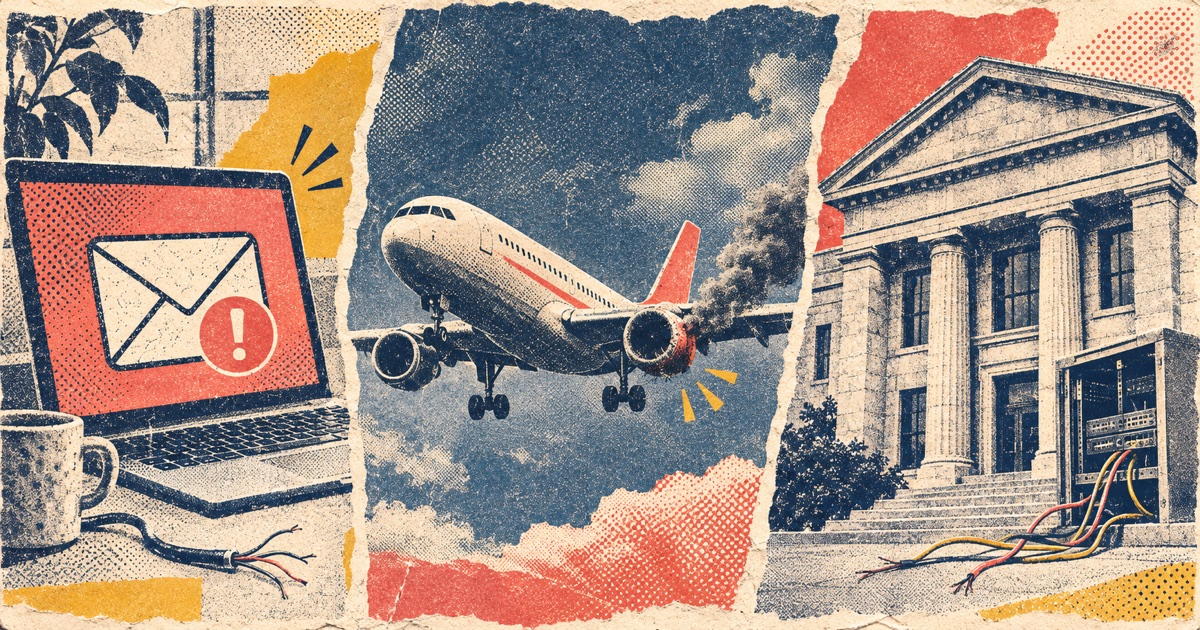
In just a few days, we've watched major technology services, banking systems, and air travel experience significant disruptions.
Microsoft 365 had a global outage.
The FAA issued a nationwide ground stop.
Chase customers struggled with banking services.
And approximately four seconds after each disruption began, the internet collectively decided we were witnessing either a massive coordinated cyberattack or the opening sequence of a disaster movie.
I understand the suspicion.
When major systems start failing within days of one another, people naturally wonder whether the events are connected.
But here's something important:
Multiple systems failing around the same time does not mean those failures share a cause.
Sometimes there's a cyberattack.
Sometimes there's a software bug.
And sometimes a piece of infrastructure everyone depends on decides it has participated in society long enough.
Let's look at what actually happened.
The November Outages: What We Know
Microsoft 365: November 12–13
Microsoft experienced widespread connectivity problems affecting Outlook and other Microsoft 365 services.
The company ultimately attributed the incident to technical problems involving its networking infrastructure. An issue introduced during an earlier network-capacity upgrade became apparent following a more recent network change.
Microsoft explicitly stated that the disruption was not caused by cyber activity or AI agents.
An actual infrastructure problem. Not an army of hackers. Not Skynet.
The FAA: November 13
The Federal Aviation Administration issued a nationwide ground stop after a technical problem destabilized parts of its telecommunications network.
According to the FAA, legacy equipment became unstable as connection attempts flooded the network at an extraordinary rate.
The agency took precautionary action, stopping departures while ensuring aircraft could land safely. It reported that air traffic resumed later that evening.
The FAA's investigation pointed to system instability involving networking equipment and routine replacement work.
The agency's public explanation did not establish that hackers caused the disruption.
For people stranded in airports, the distinction probably provided limited comfort. But it's still a critical distinction.
Chase: November 16
Customers experienced delays and difficulties accessing some banking services.
JPMorgan Chase attributed the problems to a software bug involving internal hardware systems and said the issue was not cyber-related.
The problems also affected transactions involving other financial institutions, creating the impression that several banks were simultaneously experiencing independent outages.
That's one of the wonderful features of interconnected systems: A problem in one place can become everybody's problem.
Why Does Everything Seem So Fragile?
Here's the uncomfortable answer.
Modern services depend on enormous, complicated networks of software, infrastructure, vendors, and interconnected systems.
Your banking app isn't simply a little program on your phone. It's an interface connected to authentication systems, transaction processors, fraud-detection infrastructure, databases, financial networks, and other services.
Your email service depends on servers, networking equipment, identity systems, storage, and countless technical components you never see.
Air travel relies on layers of telecommunications, scheduling, navigation, coordination, and operational infrastructure.
The complexity isn't necessarily evidence of poor engineering. Much of it exists because technology has to operate at an enormous scale.
But complexity creates dependencies.
And sometimes a seemingly routine change exposes a problem that has been sitting quietly in the system for months.
Think of it like renovating a house.
You go to replace a bathroom faucet and discover the previous owner apparently assembled the plumbing using hope, electrical tape, and a surprisingly aggressive amount of confidence.
The faucet wasn't the whole problem.
It was merely the thing that revealed everything else.
An Outage Is Not the Same Thing as a Data Breach
This distinction matters enormously.
An outage means a service is unavailable or degraded.
A cyberattack involves malicious activity targeting a system or its users.
A data breach generally involves unauthorized access to or exposure of information.
These events can overlap, but they are not interchangeable.
A ransomware attack might cause an outage.
A network misconfiguration might also cause an outage.
And a data breach can happen without anyone noticing an outage at all.
Your bank app failing to load is not, by itself, evidence that someone has stolen your money.
Similarly, a service returning to normal doesn't prove that an organization never experienced a security incident.
We need evidence, not internet panic.
Why Outages Still Create Security Risks
Here's where things get interesting.
Even when criminals didn't cause an outage, they can exploit it.
Someone who can't access their bank might search online for emergency support.
Someone whose email stopped working might click a fake recovery notification.
A stranded traveler might respond to a fraudulent refund offer.
Criminals capitalize on disrupted routines.
They know people are frustrated, anxious, and desperate for answers.
The outage creates uncertainty. The scammer supplies an explanation and a conveniently fraudulent solution.
That's why outage preparedness needs to include more than a backup Wi-Fi connection.
How to Build a Personal Digital Backup Plan
You don't need to construct an underground bunker or begin communicating exclusively through carrier pigeons.
But a little preparation helps.
1. Keep important information accessible offline
Save essential travel information, emergency contacts, important account-support numbers, and critical documents somewhere you can access if an app fails.
Keep those records protected, especially when they contain personal or financial information.
2. Have a backup payment method
If one bank or payment network experiences problems, another independently issued card or a modest amount of emergency cash may help.
Don't assume every payment method relying on the same institution is independent.
3. Protect your account recovery options
Review recovery email addresses, trusted devices, passkeys, and backup authentication methods.
Store recovery codes securely.
Ideally, your only recovery method shouldn't require access to the very service that's unavailable.
4. Verify service disruptions through official channels
Use official status pages, established customer-service numbers, and reputable news sources.
Don't trust an unsolicited text claiming to restore your account.
5. Have a family communication backup
Decide how to contact family members if your usual messaging platform fails.
For suspicious financial requests, establish a family verification routine.
At ZoraSafe, we're especially passionate about this one. A family passphrase is useful when somebody claims to be a relative and urgently needs money.
If a request can't be independently verified, don't send anything until it can.
6. Don't make a bad situation worse
If a transaction appears stuck, don't repeatedly submit it without checking its status.
If an account login fails, don't start entering credentials into random recovery websites.
If a service isn't working, sometimes the safest next step is to stop trying and verify what's happening.
Yes, occasionally doing nothing for five minutes is the more sophisticated cybersecurity response.
What We Should Demand From Technology Providers
Consumers can prepare, but major organizations also have responsibilities.
They need resilient infrastructure, realistic testing, contingency plans, clear incident communication, and systems designed to recover safely when something fails.
Reliability is not just an IT performance metric.
When technology underpins banking, travel, communication, and access to essential services, reliability becomes a public-safety and consumer-protection issue.
The goal isn't to eliminate every conceivable outage. No complex system can promise that.
The goal is to prevent predictable failures, limit their consequences, and communicate clearly when things go wrong.
The Bottom Line
If the last week has demonstrated anything, it's that modern technology is both extraordinarily powerful and sometimes spectacularly fragile.
We should absolutely scrutinize cyber incidents.
But calling every outage a coordinated attack doesn't improve security. It creates confusion and gives actual criminals an easier environment in which to operate.
Ask what happened. Look for evidence. Verify the explanation.
And keep a backup plan.
Because the internet doesn't need hackers to have a terrible day. Sometimes it can manage that all by itself.
Sources
- Microsoft 365 outage analysis — ThousandEyes
- FAA — Nationwide Ground Stop: Questions and Answers
- Associated Press — November 16 banking disruption and Chase statement
- Consumer Financial Protection Bureau — What to do when a payment app is down