
Libraries.
Wonderful places where people can borrow books, use computers, find information, attend community programs, and occasionally discover that they've apparently been holding a novel hostage since 2018.
Of all the organizations you might expect to be targeted by cybercriminals, libraries probably aren't at the top of your list.
Unfortunately, criminals aren't particularly concerned about whether their targets deserve it.
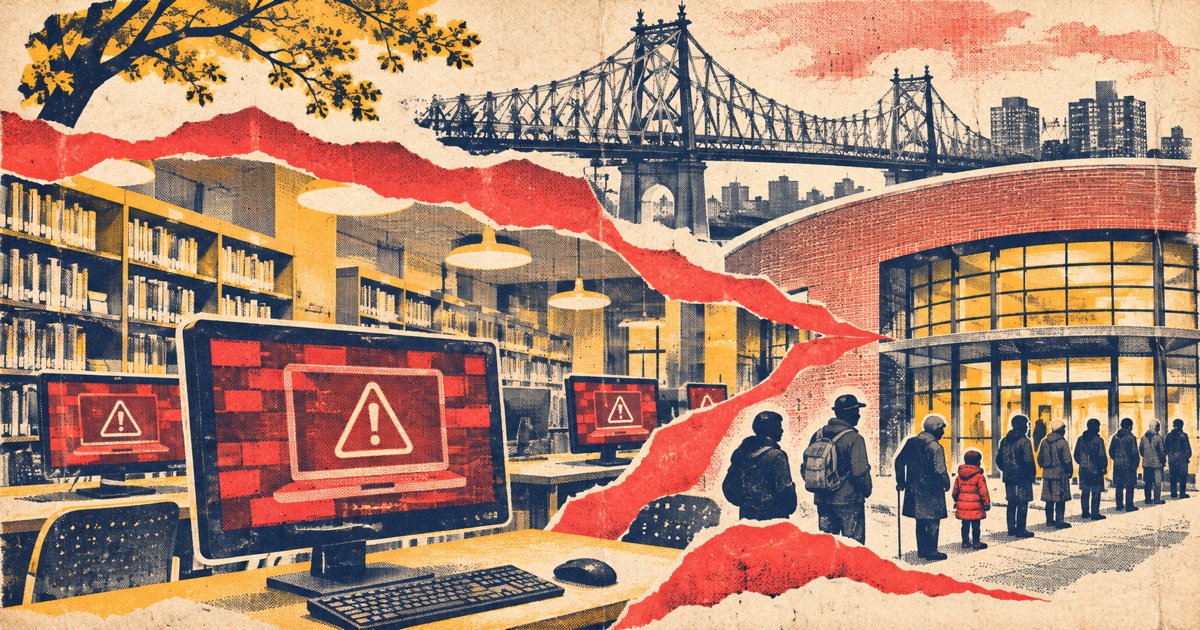
In November 2026, Queens Public Library in New York confirmed that a ransomware attack had caused a significant network outage across its system.
The disruption affected its website, mobile app, digital media services, and public computers at many locations.
The library remained open, and some essential services were restored. Its public update reported working Wi-Fi at open branches, operational checkout and return equipment, and restored public computers at seven locations.
But full recovery was still a work in progress.
The attack is a reminder that the consequences of ransomware extend well beyond corporate balance sheets.
When a public library loses digital services, the people who rely on those services lose access too.
First, What Exactly Is Ransomware?
Ransomware is malicious software or an attack that prevents an organization from accessing important systems or data, often by encrypting files.
The attackers typically demand payment in exchange for restoring access or promising not to expose stolen information.
Some ransomware operations also steal data and threaten to publish it.
Others focus on disruption or use multiple extortion tactics.
Here's the important distinction:
A ransomware incident does not automatically establish that patrons' personal information was stolen.
As of the public information reviewed for this article, Queens Public Library had confirmed ransomware-related disruption but had not established publicly whether patron records were accessed or exfiltrated.
So we're not going to invent a data breach where one hasn't been confirmed.
The attack is serious enough on its own.
Why Would Criminals Target a Library?
Because ransomware attackers generally care more about an organization's dependence on technology than its social value.
Libraries operate interconnected systems just like other organizations.
They manage user accounts, computers, digital collections, staff operations, networking equipment, and relationships with technology vendors.
Disrupting those systems creates operational pressure.
The attackers may hope an organization will pay to restore services, prevent disruption, or address the threat of information exposure.
That said, the public information available about this particular incident doesn't establish the attackers' identity or initial method of entry.
We shouldn't pretend otherwise.
What we can say is that public institutions can be especially vulnerable to the consequences of disruption because their services benefit entire communities.
A library closing digital access isn't merely an inconvenience for someone who wanted to download another mystery novel.
Who Actually Gets Hurt?
Think about the people who use a library's computers because they don't own one.
People applying for jobs.
Students completing assignments.
Older adults navigating government services.
Families accessing educational resources.
People printing documents, searching for housing, or managing essential paperwork.
Libraries help bridge the digital divide, especially for people who can't afford or easily access technology elsewhere.
When those services go offline, the impact is uneven.
Someone with a laptop, home internet, and multiple devices may be inconvenienced.
Someone whose only reliable computer access comes from the library may lose the ability to complete something essential.
That's why cybersecurity at public institutions is not just an IT budget issue.
It's an access issue, an equity issue, and a community resilience issue.
And frankly, it's ridiculous that we live in a world where a place offering free literacy programs has to prepare for digital extortion.
Does This Mean Library Members Should Panic?
No.
There's a difference between taking a security incident seriously and inventing an emergency.
If you use Queens Public Library or another institution affected by ransomware, the first step is to determine what the organization has actually disclosed.
Look for specific information about personal-data exposure, affected services, and recommended actions.
Don't assume your identity was stolen because the organization's website went offline.
Equally, don't assume everything is safe simply because services have returned.
Incident investigations can take time.
And unfortunately, criminals sometimes take advantage of publicized attacks by sending fraudulent notices claiming to help people protect their accounts.
Because apparently committing one crime wasn't enough inspiration. We need an entire supporting cast.
What Library Patrons and Families Should Do
1. Follow official updates
Check the library's verified website, official social media accounts, or established phone number.
Avoid links sent in unexpected emails claiming that your library card needs immediate reactivation.
2. Use unique passwords
If your library account uses a password, don't reuse the same one for email, banking, or shopping.
That recommendation applies whether or not the library has suffered a breach.
A password manager can help.
3. Review any official data-exposure notification
If an organization later confirms personal information was involved, review exactly what information was exposed.
The right response to a stolen email address is different from the response to exposed Social Security numbers or financial information.
Follow recommendations tailored to the actual data involved.
4. Be careful on shared computers
Public computers are enormously useful, but they're shared devices.
When using one, avoid saving passwords in the browser. Sign out of your accounts when finished.
Be cautious with sensitive financial transactions and avoid leaving personal documents or downloaded files behind.
If you need help, ask library staff about the organization's computer-use and privacy practices.
5. Don't let a service interruption become a scam
If someone contacts you claiming to be from a library's security team and demands payment, passwords, or verification codes, stop.
Contact the institution directly.
Real security incidents frequently create opportunities for impersonators.
6. Support investment in public cybersecurity
Libraries need trained staff, secure infrastructure, maintained software, incident-response plans, and reliable backups.
Those things cost money.
And they're much less exciting to fund than a new building or a ribbon-cutting ceremony.
But they're essential.
Something Good Worth Acknowledging
Despite the disruption, Queens Public Library continued providing in-person access.
Its public notice also reminded patrons that it doesn't charge late fines on borrowed materials.
The system continued working to restore services while keeping its branches available to the community.
That's meaningful.
An incident-response plan isn't just about eliminating malware. It's about preserving essential services while recovery happens.
The Bigger Picture
There's a reason ransomware is so disruptive.
Attackers understand that organizations can't simply stop operating.
Hospitals need patient systems. Schools need records and communications. Libraries need digital infrastructure. Local governments need access to essential services.
Cybercriminals exploit those dependencies.
And the human cost isn't always captured by the amount of money stolen or demanded.
Sometimes the cost is a student who can't finish an application.
An older adult who can't use the computer they depend on.
A community program that gets canceled.
A public service that becomes temporarily inaccessible.
Cybersecurity isn't only about protecting data. It's also about protecting people's ability to participate in everyday life.
So yes, let's talk about ransomware at libraries.
Let's also stop pretending that cybersecurity is somebody else's problem just because an organization isn't a Fortune 500 company.
And while we're at it, could the criminals please leave the books alone?
Libraries have enough trouble getting people to return them.
Sources
- Queens Public Library — Official Network Outage Updates
- FTC — How to recognize and avoid phishing scams